
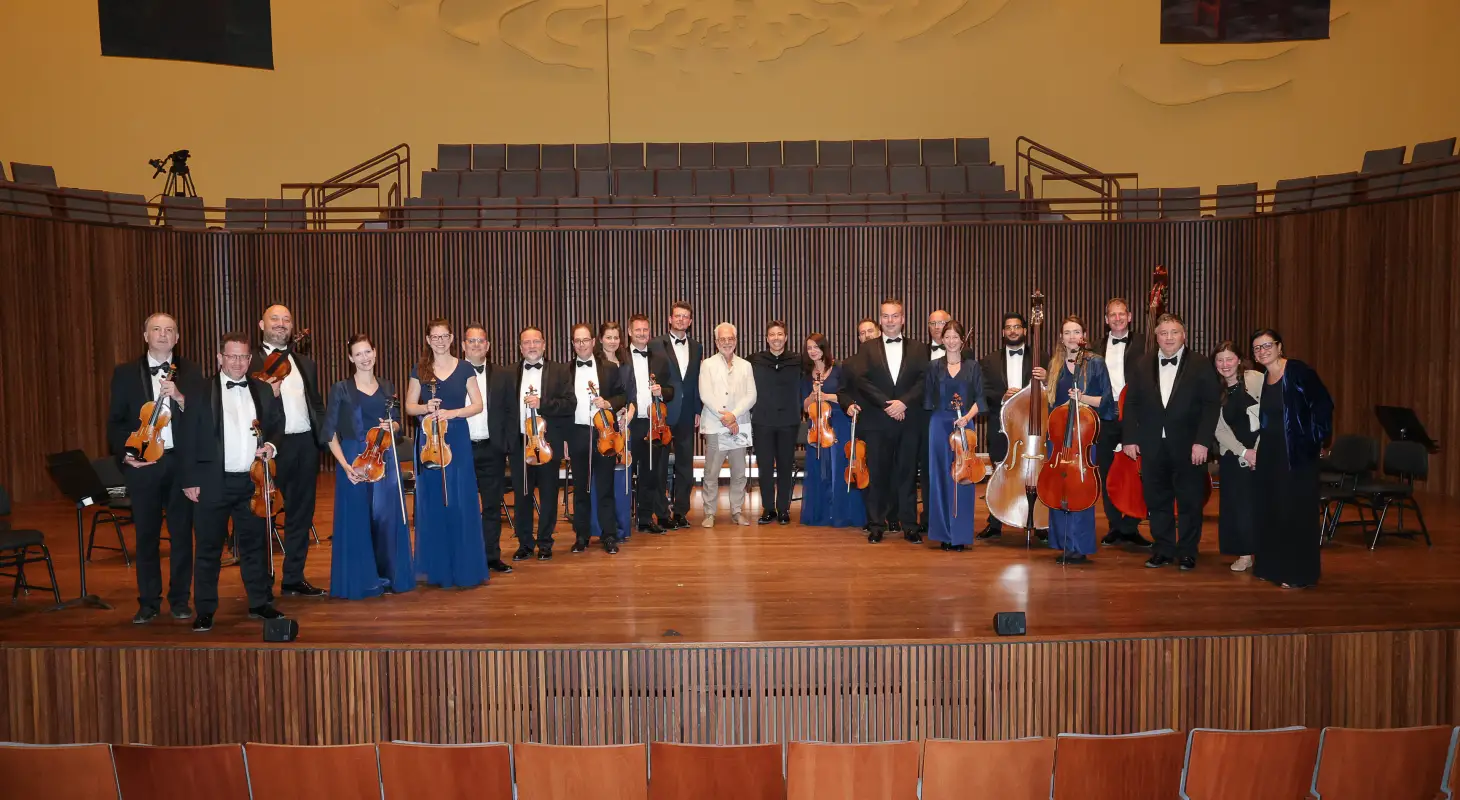
At the end of April, the Franz Liszt Chamber Orchestra performed at three remarkable concert venues across Brazil. The tour proved outstanding not only in musical terms, but also reaffirmed the ensemble’s international presence and prestige on the American continent.
Departing at dawn, with a stopover in Amsterdam, the Franz Liszt Chamber Orchestra arrived in Rio de Janeiro, where the first stop of the tour awaited them. Following the long journey, only a few hours remained for acclimatization, as an intensive rehearsal with clarinetist Pablo Barragán began that very afternoon. He appeared as the soloist in Mozart’s popular Clarinet Concerto. The collaboration between the artist and the orchestra is by no means recent: over the past three years, they have demonstrated their exceptional musical rapport at numerous prestigious festivals, at Budapest’s Liszt Academy, and on a joint recording entitled Szinergia / Synergia.
The concert took place in one of Rio’s most iconic buildings, the Teatro Municipal, inaugurated in 1909. Modelled after the Paris Opera House, it stands as one of the city’s most important cultural landmarks. The evening opened with Mozart’s Adagio and Fugue, followed by the Clarinet Concerto performed by Barragán. In the second half, Schubert’s C major Quintet was presented in an orchestral arrangement. The ensemble was conducted by Artistic Director István Várdai, who also appeared as a cellist in the latter part of the programme. The audience responded with enthusiastic applause already after the first half, and the concert concluded with several encores.
The second stop of the tour led to an extraordinary setting: the island of Ilhabela, which the orchestra reached under adventurous circumstances, travelling by air, water, and land. At Rio de Janeiro airport, after check-in and baggage drop-off, it became clear at the departure gate that the group was in fact scheduled to depart from another airport—information that had not been communicated in time by airport staff. With swift decision-making, the entire orchestra, with their instruments in tow, boarded taxis and set off toward São Paulo in an improvised logistical reorganization. They arrived at the airport with a five-hour delay, from where a transfer bus took the musicians to the ferry leading to the island.
Upon arrival on Ilhabela, it was not yet clear what extraordinary natural surroundings would host their next performance; however, the following day’s scenery more than compensated for any uncertainty. The Verhelmos Cultural Complex – a modern theatre and concert hall seating 1,200 – lies in the heart of the jungle, in a truly unique natural environment. The special atmosphere of the venue proved deeply inspiring for the musicians: the seventy-minute concert by the string ensemble created a vivid and engaging musical atmosphere. The programme concluded with excerpts from popular works by Brahms, Shostakovich, and Pavel Fischer, and the audience rewarded the performance with a standing ovation, followed by three encores. The warm, intimate reception and the closeness of nature made it difficult for the orchestra to bid farewell to this exceptional location.
The final concert of the tour took place in São Paulo, Brazil’s bustling cultural hub. The performance was hosted by the Teatro Artística, renowned for its excellent acoustics and a space ideally suited to chamber music. At the heart of the evening stood Schumann’s Cello Concerto, performed by István Várdai, who appeared once again as a soloist of compelling artistic presence. The subtlety and expressive intensity of the performance offered a fitting close to the tour.
For the Franz Liszt Chamber Orchestra, this Brazilian series represented not only a professional success, but also a worthy crowning of the season. Following their concert series in Colombia three months earlier, the ensemble was able to return once more to the continent to represent Hungarian musical traditions and the artistic excellence of its musicians. The tour once again confirmed that, through its high artistic standards and long-standing international collaborations, Hungarian chamber music culture remains vibrant, sought-after, and widely respected in the world’s leading concert halls.